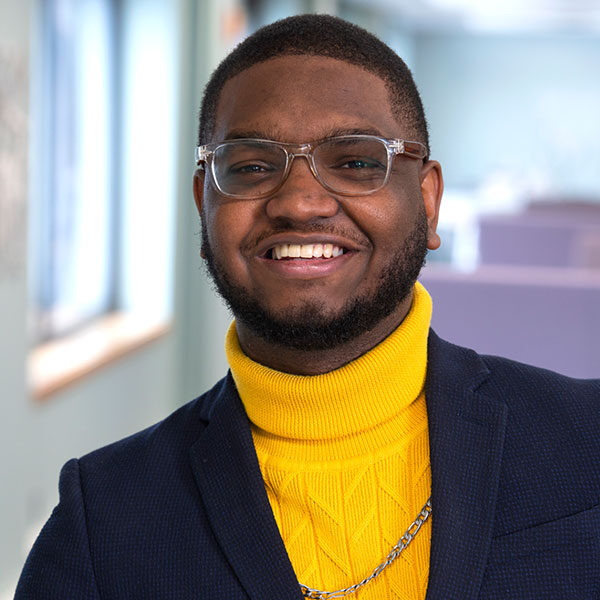
Meet SIOP Student Member Nathan Price
Name
Nathan Price
Position/Employer
Founder of The Academic IO
How long have you been a SIOP member?
8 years
What roles have you had within SIOP?
LGBTQIA+ Committee member
Visibility Committee Member
Local I-O Group Leader for The Academic IO
Interest area(s)
I-O Practice in Academic Environments; Leadership and Organizational Development; Coaching and Consulting; Entrepreneurship; Career Pathways and Practitioner Development
What sparked your interest in I-O psychology?
I always knew I wanted to be in psychology, but I also battled with seeing myself in a business setting. So in undergrad, I double majored in both psychology and business. During that time, I worked within student affairs with 200+ students at different points, focusing on student engagement, coaching, leadership development, and first-year experience programming. I was also involved in several organizations, including McNair Scholars and fraternities. Looking back, I did not have the language yet, but I truly loved working with people, organizations, and leadership development in these spaces.
During my junior year, I remember being frustrated and flustered because I did not know where I could go professionally. I felt like I had to create a whole new field that blended psychology, business, leadership, and human development. Then I saw a TV commercial that listed industrial-organizational psychology as one of the programs. I looked it up and remember saying, “This is what I want to do for the rest of my life.”
Later, while working at another institution, I saw the darker side of academia. One defining moment came when I experienced one of two hate-crime incidents within the department where I lived and worked. In that moment, I knew the issue was much larger than one institution. I made a vow that I would use my research and practice to apply I-O psychology to academic environments so we could create happier, healthier, high-functioning spaces where all could thrive.
What role do you see I-O psychology playing in the future of work?
I always jokingly tell people that I have tried to leave academia, but academia is home for me—just not in the traditional faculty way. I believe I-O psychologists can create major impact in academic spaces as practitioners, consultants, coaches, researchers, and internal interventionists. When I think about the issues academic leaders are facing, I see burnout, retention, leadership development, role clarity, employee engagement, culture, performance, and change. These are all areas where I-O psychology has so much to offer.
The challenge is that in academia I often hear, “That’s just how academia works,” instead of people naming, addressing, creating, and enhancing the people systems that shape the environment. One of the biggest lessons I have learned is that we have to translate our science in ways academic leaders can actually receive. If they only hear it as HR jargon, they may miss how much their daily leadership practices impact employee engagement, the employee lifecycle, faculty and staff experience, and the overall health of the institution.
That is also why I created the LEADERS model. As I-O psychologists, we understand it through the lens of the employee lifecycle, but for academic leaders, the model helps make clear that creating healthy people systems is part of their charge. This is the premise of why I built The Academic I/O: to support I-O psychologists who want to impact academic spaces by helping them understand the realities, structures, and language of academia. The bureaucracy will always be there, and issues will arise daily, but I envision a world where academic systems can fully thrive. That starts by supporting not only students, but also the faculty and staff who support them. Sometimes that begins with one institution, one college, one dean, one department chair, one division head, one director, or even one team.
What work trends are you seeing and hearing about, and how can I-O psychology practitioners, educators, and students impact these trends?
One major trend I am seeing is that academic institutions are being asked to change, but many leaders have not been trained to redesign the people systems needed to support that change. Leaders are navigating burnout, retention challenges, policy shifts, student needs, financial uncertainty, role ambiguity, and cultural strain while trying to preserve mission-driven work.
In these spaces, I often say there is a difference between being an academic leader who understands I-O psychology and being an I-O psychologist who knows how to impact academia. Both are needed. Academic leaders need practical tools and language to apply evidence-based practices. I-O psychologists need contextual fluency in shared governance, decentralization, institutional politics, academic culture, and the pace of change in education.
Practitioners can design interventions that fit academic systems. Researchers can study academic workplaces as complex organizations. Educators can expose students to nontraditional I-O pathways. Students can stay curious, build community, and learn how to translate the science into language different audiences can use.
For me, this is why The Academic I/O exists. If I do not see the space, I believe in helping create it.
What one piece of advice would you give to someone who is looking to secure their first role in the field of I-O psychology?
Some people secure roles that are clearly labeled as I-O psychology, and others enter roles where the work is I-O-aligned even if the title is not. Learn to recognize both.
Look at the work underneath the job title. Are you helping improve selection, training, leadership, coaching, assessment, employee experience, organizational effectiveness, workforce development, or change? If so, there may be room to shape the role into I-O practice.
Also, do not search alone. Reach out to people in your community. Ask how they describe their work, what titles they search for, what skills they use, and how they found their way in. Sometimes your first I-O role is not found by typing “I-O psychologist” into a search bar. Sometimes it comes from understanding how your expertise translates.
Are there any skills you would recommend someone highlight or enhance to help them secure a role in I-O psychology?
Yes: translation, communication, relationship-building, and applied problem-solving.
As a field, we do not always market ourselves well. People outside of I-O psychology may not understand what we do, what workplace science is, or why our expertise matters until something has already gone wrong. That means we have to get better at explaining the need before the crisis.
I would encourage people to strengthen their ability to translate I-O concepts into language that different audiences can understand. Learn how to explain the value of selection, coaching, engagement, leadership development, organizational culture, performance, and change management without relying only on technical language.
A strong reputation, clear communication, and the ability to connect science to real organizational needs will take you far. Do not try to conquer the world in one day. Build skill, build trust, build relationships, and build a legacy.
Is there any guidance you would provide to a job seeker given the current challenging state of the job market?
Your path may take you somewhere you did not expect, so be proactive and flexible at the same time.
In a difficult job market, it is easy to question your value, especially after rejection, silence, or a layoff. But your worth is not determined by one role, one organization, or one season. Sometimes the path only makes sense when you look backward and see how each experience gave you language, skills, resilience, and direction.
Look for places where your work will be celebrated, not merely tolerated. Be open to roles that may not have the exact title you imagined but still allow you to use your strengths. Keep building relationships, asking questions, and translating your experience into the value you can create.
And when the opportunity you need does not yet exist, do not be afraid to help create it. That has been much of my own journey, and it continues to shape the work I do today.
What is one of your favorite SIOP Annual Conference memories/highlights?
The SIOP Annual Conference feels like a family reunion to me. It is a family that truly understands the quirks, systems, questions, and realities of the work we do. Every year, I feel like more people get added to the family tree.
For me, the conference is not just about learning what is currently happening in the field. It is also an opportunity to encourage, uplift, and celebrate those who have paved the way, those who are going to change the world through research and practice, and those who are doing great work but may feel alone in the daily fight of improving organizations. We also cannot ignore those who have recently lost jobs, had to pivot, or are trying to find their next opportunity in the field. I believe it is our charge to take care of our community the best way we can.
The charge I bring every year is to be present, engage with every person I come in contact with, and show the love that is well deserved and needed. We come together to advance the field and each other. So if you see me at the SIOP Annual Conference, no matter how dapper I look from year to year, just know that I am here and will always be here as a resource, opportunity mapper, friend, mentor, and one of your biggest supporters.
Please share one non-I-O-related bit of information about yourself.
I have a deep passion for working with adolescent youth because of my own path. Many people would not know that I was once classified as a troubled youth. I went to anger management, got in trouble more times than not, and had to grow through correction, support, and grace. That journey shaped me, and now I want to be part of that journey for others by giving young people some of the same opportunities that helped make me who I am today.
I serve in youth ministry at my local church, and I also do work in local communities connected to workforce development for students. For me, it is not only about supporting faculty and staff, but also about supporting our future leaders. I care deeply about helping young people see what is possible for their lives and giving them the tools, encouragement, and exposure to walk toward it.
Of course, working with youth means I have endured a couple of old jokes, attitudes on bad days, and humbling moments. But seeing them shape the world, see life differently, and celebrate their accomplishments means the world to me.
Is there anything you’d like to add?
The Academic I/O is a bridge between I-O psychology and academic leadership. At its core, the work is about helping people understand how I-O psychology can be used to strengthen academic environments and support the people who learn, lead, teach, and work within them.
The work of The Academic I/O has three major lanes. The first is supporting academic leaders through coaching, consulting, leadership development, team interventions, clinics, and practical tools that help create healthier and higher-functioning departments, colleges, schools, and institutions. The second is supporting I-O psychologists, students, and I-O-adjacent professionals by helping them understand how I-O psychology shows up in academia through community conversations, events, trainings, and opportunities to practice working in these spaces.
The third lane is creating what we do not yet see. Through collaborations such as the HBCU I-O Psychology Task Force with Blacks in I-O Psychology, The Academic I/O is working to expand access, outreach, and pathways for the future of I-O psychology. If we can see it, dream it, and build the right community around it, we can help make it happen.
Ultimately, The Academic I/O is building a community for people who believe academic environments can be better for the faculty, staff, students, and leaders who make them work. To connect, check out the website, join The Academic I/O community, and let’s see what we can co-create together.
If you would like to be considered for a Membership Spotlight, please fill out this form.