
This article was submitted by SIOP Military and Veterans Inclusion Subcommittee member Dr. Jonathan D. Rock.
Organizations often celebrate the strengths veterans bring to the workforce while overlooking the hidden costs of military service. Veterans transitioning into civilian roles bring a sense of discipline and adaptability shaped by years of military-related service, and organizational leaders must recognize how invisible injuries, such as PTSD, influence team dynamics. Prevalence varies by service era, with veterans of Operation Iraqi Freedom and Operation Enduring Freedom reporting the highest rates of PTSD occurrences within the past year. Veterans of the Vietnam War and earlier eras carry meaningful, lasting risk decades later, according to the Department of Veterans Affairs National Center for PTSD. Veterans are already part of your workforce. Taking their experiences seriously and adjusting how teams support them helps guide veterans to a successful transition.
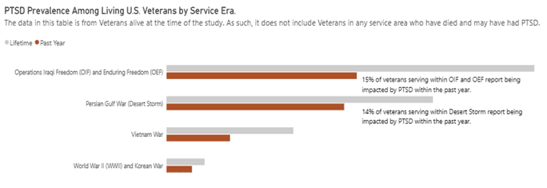
Data adapted from the U.S. Department of Veterans Affairs National Center for PTSD (https://www.ptsd.va.gov).
The symptoms of PTSD tend to show up as flashbacks, hypervigilance, disrupted sleep, and withdrawal, which a veteran conceals when the workday starts. When these symptoms go unaddressed, they can intensify, which carries the risk of self-harm or suicide (Forehand et al., 2022). Depression often accompanies PTSD, and within the workplace environment, it generally is shown through absenteeism, disability claims, and presenteeism, where someone is physically present but cannot fully function. PTSD is not a fixed trait. How a team responds can be the difference between a veteran struggling in silence and a veteran thriving within a supportive network.
Research on successful veteran-focused programs points to two connected outcomes: Peer support reduces the isolation that often comes with the transition out of service (Reger et al., 2024), and employment-focused interventions have helped veterans find steadier footing through measurable gains in job retention and earnings (Bond et al., 2022). This evidence has shown that the concept of connection greatly impacts a successful transition for someone with PTSD post-military service. This is not a new concept; when looking at onboarding any new hire, veteran or not, individuals settle in faster when a peer is present with social mentoring to strengthen resilience and self-efficacy (Choi & Yu, 2022). The battle buddy concept veterans already know from service translates to this scenario by pairing a new veteran hire with someone who can walk them through team norms, understanding hierarchies, and managing meetings. That relationship works precisely because it’s built on trust. The value of trust works within the same dynamic as connection with veterans, viewing trust not as a choice but as a concept of survival. Higher unit cohesion built on trust and camaraderie has been shown to predict a lower risk of developing PTSD, depression, and anxiety following deployment (Anderson et al., 2019); building that same kind of trust into a civilian team culture may offer a similar protective effect.
When considering veteran PTSD, there are several accommodations that any organization can implement to ensure a psychologically safe work environment. None of these suggestions require disclosure, protecting the individual’s confidentiality while preventing the hesitation that comes with fearing judgment for an underlying condition. To best serve a veteran, an organization can offer universal policies to address desk placement, flexibility for therapy or appointments without explanation, and access to a quiet space when needed. All the suggested accommodations, when made openly available instead of needing to be requested, can reduce avoidance to seeking help and facilitate a veteran’s transition into civilian workplace norms.
Within the military culture, service members and veterans generally strive to maintain emotional control and self-reliance. With this, veterans transitioning out of the service who experience mental health problems often avoid seeking help, citing fear of judgment and masculine identity norms (Clary et al., 2021). This poses a concern, with prolonged exposure and cognitive processing therapy being the most effective PTSD treatments, which require the veteran to be emotionally open, which as stated prior veterans tend to avoid. This becomes even more difficult when moral injury accompanies PTSD, because shame reinforces the same silence (Norman et al., 2022).
Veterans tend to favor direct communication, for example the military’s BLUF (Bottom Line Up Front) mindset where the sentiment of the statement is addressed first before an explanation is warranted. That communication style does not always translate to civilian workplaces, which tend to rely more on relationship-driven, less hierarchical interaction (Mael et al., 2022). These two communication styles can clash, leaving both sides frustrated. Naming the difference can help bridge this gap. Managers can verbally model both versions of a message, showing the direct version and rephrasing the sentiment to the current scenario. This rephrasing helps the veteran maintain their own communication style, while being exposed to the civilian workplace norms, without it working against them.
Employing transitioning veterans brings unmatched dedication and loyalty to the workplace, but true integration means accounting for the invisible barriers that can hold them back. Inclusion is built through intentional communication, active attention, structured mentorship, and the space for trust to develop naturally rather than by assumption. That is the real work of veteran inclusion. The expectation of turning passive appreciation into a standard for actively bridging gaps and making accommodations openly available without requests for access to support true inclusion.
Get involved or learn more here:
- Edit your My Account – Profile on siop.org to include Additional Information on your interests and to identify your Veteran Status to receive information from SIOP about military, veterans topics, and the MVI.
- The SIOP team can create MIL/VET and MVI distributions from members who have selected a veteran, actively serving, or neither actively serving nor a veteran from the veteran status drop-down options (fifth input in the last tile). “Neither” would include all supporters of the military community, including spouses, dependents, DoD, and beyond.
- Contact MVI directly to submit your questions or a request for engagement or further collaboration.
References
Anderson, L., Campbell‐Sills, L., Ursano, R. J., Kessler, R. C., Sun, X., Heeringa, S. G., Nock, M. K., Bliese, P. D., Gonzalez, O. I., Wynn, G. H., Jain, S., & Stein, M. B. (2019). Prospective associations of perceived unit cohesion with postdeployment mental health outcomes. Depression and Anxiety, 36(6), 511–521. https://doi.org/10.1002/da.22884
Bond, G. R., Al-Abdulmunem, M., Ressler, D. R., Gade, D. M., & Drake, R. E. (2022). A Randomized controlled trial of an employment program for veterans transitioning from the military: Two-year outcomes. Administration and Policy in Mental Health and Mental Health Services Research. https://doi.org/10.1007/s10488-022-01208-z
Choi, E., & Yu, S. (2022). Effects of preceptors’ mentoring function on novice nurses’ self-efficacy and organizational commitment: A cross-sectional study. Nurse Education in Practice, 64, 103431. https://doi.org/10.1016/j.nepr.2022.103431
Clary, K. L., Pena, S., & Smith, D. C. (2021). Masculinity and stigma among emerging adult military members and veterans: Implications for encouraging help-seeking. Current Psychology, 42. https://doi.org/10.1007/s12144-021-01768-7
Forehand, J. A., Dufort, V., Gradus, J. L., Maguen, S., Watts, B. V., Jiang, T., Holder, N., & Shiner, B. (2022). Association between post-traumatic stress disorder severity and death by suicide in US military veterans: Retrospective cohort study. British Journal of Psychiatry, 221(5), 1–7. https://doi.org/10.1192/bjp.2022.110
Mael, F., Wyatt, W., & Iyer, U. (2022). Veterans to workplace: Keys to successful transition. Military Psychology, 34(5), 516–529. https://doi.org/10.1080/08995605.2021.2016307
Norman, S. B., Nichter, B., Maguen, S., Na, P. J., Schnurr, P. P., & Pietrzak, R. H. (2022). Moral injury among U.S. combat veterans with and without PTSD and depression. Journal of Psychiatric Research, 154, 190–197. https://doi.org/10.1016/j.jpsychires.2022.07.033
Reger, M. A., Legler, A., Lauver, M., Tenso, K., Manchester, C., Griffin, C., Strombotne, K. L., Landes, S. J., Porter, S., Bourgeois, J. E., & Garrido, M. M. (2024). Caring letters sent by a clinician or peer to at-risk veterans: A randomized clinical trial. JAMA Network Open, 7(4), e248064. https://doi.org/10.1001/jamanetworkopen.2024.8064
Post Type
Source
Topic
Committees, Military and Veterans Inclusion, Veterans Issues