
Introduction
Industrial-organizational (I-O) psychology plays a critical role not only in traditional business settings but across academic environments as well. Although the common pathways in the academic settings include applied research, professorship, or teaching, academic institutions are often complex organizations that depend on competencies central to I-O psychology throughout the entire ecosystem for successful administration of services, embedding practitioner roles within academic spaces. One such setting is within career services, where recruiting processes, assessment practices, and stakeholder decision-making converge. Here, staff play a key role in how students are supported while identifying career paths, building interview readiness, and making informed decisions around job offers.
This article highlights how the I-O principles are embedded in career services and employer relations functions at the Tuck School of Business at Dartmouth College (henceforth, Tuck School of Business), as an example of academic environments that blend higher education, talent strategy, and recruitment operations to support both the students and organizational partners through the services offered.
The Tuck School of Business Community
Tuck[ed] into the woods of New Hampshire, the Tuck School of Business has a highly selective MBA program and aims to provide a personal, connected, and transformative experience. These values are embedded in the fabric of Tuck, including Career Services, where the associate directors apply the school’s mission and vision directly to the recruiting process and employer engagement. The recruiting program prioritizes relationship-based interactions through repeated, structured opportunities for ongoing engagement, personalized communication, and trust building, an emphasis that is reinforced across the MBA core curriculum through sustained, relationship-driven learning experiences. Career Services sponsors a “recruiting” program to help employers engage with students through hosted on-campus, virtual, or experiential events, and internships that often serve as pipelines to full-time employment for students, shortly after graduation.
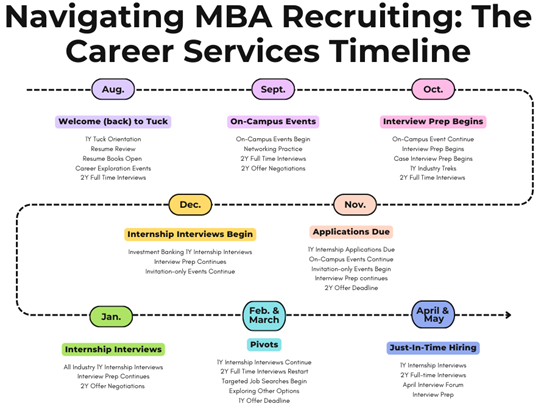
An understanding of I-O psychology principles, particularly in the validation and use of selection procedures, informs how this role supports employers in their recruitment of MBA students, even though Career Services does not manage employers’ internal hiring processes. Instead, I-O and recruiting process expertise is applied within the MBA career services day-to-day processes, which serves as an intermediary among academic priorities, employer hiring needs, student preferences, and equitable access and treatment for all participants across the recruiting timeline (Figure 1, below).
Figure 1: Example Recruiting Program Timeline Sponsored by Career Services
Additionally, practitioners within Career Services offices offer strategic insight (i.e., consulting) on how the partner’s organizations can effectively engage and evaluate the student population throughout the recruiting process by educating employers on the best practices for assessing applicants in the hiring process and coaching students during their transition from the classroom into the workforce.
I-O Principles Embedded in Daily Practice
I-O psychology is leveraged throughout the role in both explicit and implicit ways. Staff roles in higher education often function as bridges connecting candidates and students to employers or companies by designing standard processes that promote fairness and reduce bias in the sponsored events. This work supports a shared understanding of how students will be evaluated as candidates and promotes the understanding of the role and impact of assessments in the process, allowing both students and employers to use and understand fair hiring processes. Data analytics further inform this work when used to monitor outcomes, such as offer rates, reporting rates, and recruiting/timing trends, enabling evidence-based adjustments and continuous improvement.
In this I-O work context, we act as interpreters, bridging academic importance and career coaching with real-world constraints and company needs.
Structured Recruiting Timelines and Assessment Education
Within companies, recruiting processes should be intentionally structured to promote consistency and transparency, and the same applies to offices like Career Services. This includes standardized timelines, clear policies and procedures for interactions and events, and guidance on interview structure. Career Services encourages the employers partnered with the school to be transparent about hiring assessments and ensure alignment between the assessments or criteria used in the hiring process and the role-relevant competencies, improving face validity, the candidate’s experience, and selection quality. Specific to this role at Tuck, because there is an I-O lens, there is often the ability to discuss the implementation strategy of the assessments used within the hiring process, beyond organizational buy-in. For example, the associate director of Career Services often works directly with employers to discuss how assessment choices and implementation decisions (such as timing, communication, and format) affect both hiring processes and candidate reactions. These insights are translated into student-facing education through structured presentations on assessment expectations, common formats, and best practices, as well as into internal guidance for the career services team regarding assessment practices currently being used in the MBA hiring market.
Data Analytics and Continuous Improvement
Data are monitored throughout the MBA hiring cycle to identify patterns, changes in the markets, and overall trends. We are also consistently evaluating the needs of the companies and students. Job market data, qualitative stakeholder feedback from employers and event coordination efforts, student outcome metrics, and students’ targeted employer lists are synthesized to inform adjustments to processes, communication strategies, and employer guidance.
Coaching and Stakeholder Education
A significant portion of the role involves educating employers as well as coaching students. Students are supported in understanding timeline navigation, networking opportunities and strategy, preparing for structured interviews, and making informed decisions when offers are in hand. Employers receive consultation and feedback on recruiting practices, timeline strategies, and emerging trends across their industries.
Looking Ahead: Expanding the Boundaries of I-O Practice
The academic recruiting events present unique circumstances that differ from corporate or consulting contexts. Hiring event cycle timelines are compressed, participants have competing priorities, and success from the career service/associate director’s duties depends heavily on influence rather than authority.
At the same time, the environment offers opportunities for meaningful impact. Small process changes, such as improved communication, can affect outcomes for an entire class of students, and the right recruiting strategy for a company can ensure its pipeline is effective and sustainable for years to come.
All the Places We Can Go
This role illustrates how I-O psychologists can contribute outside traditional job titles or settings. Higher education career services or recruiting functions increasingly rely on data, more now than ever–some assessment expertise and systems thinking.
For practitioners interested in talent acquisition, workforce development, or applied consulting, career services and academic recruiting environments offer meaningful, scalable opportunities to apply I-O science in practice.
Want to learn more about I-O beyond corporate walls with applications in universities, K-12, and workplace systems? Join Nathan Price, myself, and other knowledgeable academic-based staff at the 2026 SIOP Annual Conference for I-Os in Academic Spaces: All the Places We Can Go, April 30 from 9:00-10:20 am.
Conclusion
I-O psychology plays a critical role in shaping recruiting systems that are effective, equitable, and data-informed. Within MBA career services, staff can apply I-O principles to influence hiring processes, support stakeholder decision-making, and improve talent outcomes at scale. As the nature of work and hiring continues to evolve, these hybrid environments represent an important and often underrecognized domain for applied I-O practice.
For Further Reading
Bauer, T., McCarthy, J., Anderson, N., Truxillo, D., & Salgado, J. (2020). What we know about the candidate experience: Research summary and best practices for applicant reactions. SIOP White Paper Series. https://www.siop.org/wp-content/uploads/legacy/docs/White%20Papers/candidate%20experience.pdf?ver=2020-07-02-073420-397
Bauer, T., McCarthy, J., Anderson, N., Truxillo, D., Salgado, J., Zugec, L., Bhupatkar, A., Pugh, D., Johnson, G., Klein, S., & Krauss, A. (2012). What we know about applicant reactions to selection: Research summary and best practices. https://siop.org/wp-content/uploads/legacy/docs/SIOP-SHRM%20White%20Papers/SIOP-Applicant_Reactions_to_Selection_final.pdf
Day, D. V., & Dragoni, L. (2015). Leadership development: An outcome-oriented review based on time and levels of analysis. Annual Review of Organizational Psychology and Organizational Behavior, 2, 133–156. https://doi.org/10.1146/annurev-orgpsych-032414-111328
Kozlowski, S. W., Mak, S., & Chao, G. T. (2016). Team-centric leadership: An integrative review. Annual Review of Organizational Psychology and Organizational Behavior, 3, 21–54. https://doi.org/10.1146/annurev-orgpsych-041015-062429
Price, N. (Chair/Speaker), Turner, S. (Co-Chair/Speaker), Ahmed, Y.(Speaker), Alamanteoff, J.(Speaker), Albertie, M.(Speaker), Baines, S.(Speaker), Fannin, A.(Speaker), Goyal, C.(Speaker), Larson, E.(Speaker), Lew, V.(Speaker), Lorenza, T.(Speaker), Marshall, K.(Speaker), McChesney, J(Speaker)., Mendelson, R.(Speaker), Mont, E.(Speaker), Reichin, S.(Speaker), Thornton, J.(Speaker), & Wynne, K.(Speaker), Burchett, B., McCoy, J., Peguese, A., Robinson, L., Thomas, K., (2026, April 30–May 2). I-Os in academic spaces: All the places we can go [Alternative Session Type without Multiple Papers]. Society for Industrial and Organizational Psychology Annual Conference, New Orleans, LA, United States.
Tuck School of Business at Dartmouth. (n.d.). Mission, values, vision. https://tuck.dartmouth.edu/about/mission-values-vision
Volume
63
Number
4
Author
Stephanie Turner, Tuck School of Business, Military and Veterans Inclusion Committee
Topic
Careers
