As I-O psychologists and organizational leaders, we’ve become intimately aware of how challenging times may negatively impact employees’ engagement at work. According to Gallup Workplace, employee engagement is at an all-time low, with only about 31% of employees engaged (Harter, 2025); this means 69% of the workforce is either disengaged or actively disengaged. Those statistics are staggering.
When work consumes such a large part of one’s life, it is disheartening to think that organizational leaders have not created a work environment where employees or managers feel engaged and passionate about their work. Therefore, as I-O psychologists, we must encourage organizational leaders to take an intentional, active role in creating a diversity work climate that nurtures employees’ passion for work. More importantly, as the translators of high-level organizational strategy into daily tasks that drive performance, cultivating middle manager work passion is key to achieving optimal outcomes.
As we explore this topic further, this article draws heavily on the empirical evidence in my dissertation, “Predicting Work Passion: A Multiple Regression Analysis” (Simmonds-Emmanuel, 2022). Leveraging the Employee Work Passion Appraisal (EWPA) model by Zigarmi et al. (2009), the study explored how traditional antecedents, such as organizational, job, relationship, and personal characteristics, combine with crucial contemporary variables, specifically diversity work climate, motivation, and mindfulness, to predict passion outcomes. To gain a better understanding of high-demand professions and high-stress work environments, it focused particularly on healthcare middle managers who self-identify as people of color, addressing a crucial gap in work passion research regarding diverse populations and specific occupational levels. The insights from this research can serve as a gateway to further explore work passion in other cultural and occupational contexts, challenging organizational leaders and I-O psychologists to go beyond employee engagement.
Work Passion… Really?
Work passion is one of the most coveted but least understood drivers of workplace success. In our roles, leveraging empirical evidence to address organizational challenges and foster inclusive, thriving environments is a core tenet of industrial-organizational psychology.
Before we go any further, let’s level set to ensure that we are all “on the same page” when we refer to employee work passion and the dual model of passion, which are essential to understanding this phenomenon and its application. According to Zigarmi et al. (2009), employee work passion is defined as “an individual’s persistent, emotionally positive, meaning-based, state of well-being stemming from reoccurring cognitive and affective appraisals of various job and organizational situations” (p. 310). This means that employees are constantly appraising their work, roles, and organizations, which affects how they think, feel, and intend toward their work. When this definition is explored through the lens of Vallerand’s (2012) dual model of passion, it can be viewed as follows:
- Harmonious passion (HP): The adaptive outcome, where motivation is autonomous and intrinsic. HP is associated with positive psychological well-being, enhanced performance, and a work–life that complements personal life.
- Obsessive passion (OP): The maladaptive outcome, driven by external pressures, resulting in a rigid need to engage. OP is associated with negative outcomes, including burnout, anxiety, stress, and conflicts with other life areas.
Regardless of which passion is cultivated, employee performance and well-being hinge on work passion. Therefore, to address unpredictable work passion, focusing on identifying specific, measurable levers—most notably, those that influence the dual model of harmonious passion (HP) and obsessive passion (OP)—is critical. The study’s findings indicated that motivation and the diversity work climate are statistically significant drivers of both forms of passion. Most importantly, the combination of diversity work climate, relationship characteristics, and motivation yields the highest predictive power for harmonious passion—explaining 61.1% of its variance (Simmonds-Emmanuel, 2022). By analyzing these key predictors, we gain actionable, data-driven guidance for creating passionate, thriving organizations. Figure 1 shows the key variables of harmonious and obsessive work passion, along with outcomes (performance, well-being, and work–life complement) based on the study.
Figure 1
Key Predictors and Outcomes of Work Passion
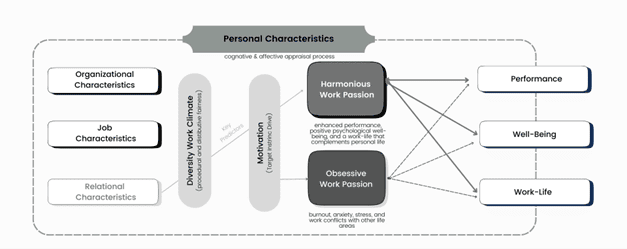
Note. This figure shows the employee work passion appraisal (EWPA) model’s antecedents of organizational, job, and relationship characteristics, along with the key variables of diversity work climate and motivation that predict harmonious or obsessive work passion. All variables are viewed through the lens of participants’ personal characteristics, as assessed through cognitive and affective appraisal processes, which impact performance, well-being, and work–life aspects.
The Problem: When Lack of Understanding Becomes a Liability
As I-O psychologists and organizational leaders, our primary task is to optimize human performance and well-being within complex organizational systems. Central to this goal is understanding work passion, an attribute that is “highly sought-after, yet poorly understood (and cultivated) work attribute” (Perrewè et al., 2014, p. 145).
How do we predict and nurture the work passion of a growing, diverse workforce? Based on the study, which involved healthcare middle managers who self-identified as people of color, I-O psychologists and organizational leaders must identify and address which organizational factors reliably predict adaptive HP and limit destructive OP. The central problem has been that traditional approaches have ignored key environmental and cultural factors that affect passion.
The Solution: Targeting the Predictors of Thriving Passion
The EWPA model can be expanded by applying social cognitive theory, which highlights the influence of social and environmental contexts on behavior. It centers on key levers—organizational, job, and relationship characteristics, combined with diversity work climate, motivation, and mindfulness—offering a comprehensive framework for intervention viewed through personal characteristics. The statistical models featured, based on feedback from healthcare middle managers of color, provide three practical insights for shaping human resources, organizational development, and leadership interventions.
Insight 1: Motivation and Diversity Climate Are Dual Predictors of Both HP and OP
Initial analysis indicated that motivation and diversity work climate are statistically significant, unique predictors of both harmonious and obsessive work passion. Motivation pertains to the internal energy or external forces that shape an employee’s behavior, intensity, and duration. For leaders, it reinforces the need to understand why employees engage—shifting the motivational source toward self-determined or intrinsic motivation to enhance the likelihood of HP. Whereas diversity work climate relates to the employee’s perception that the organization supports diversity through fair practices, equitable treatment, and inclusion. The significance of this variable underscores the impact of organizational justice (procedural and distributive) on the passion development process for diverse employees. This is a critical finding because it shows that these two constructs are fundamental levers that determine whether an employee’s passion takes an adaptive or a maladaptive path.
For organizational leaders, this finding reinforces the importance of understanding what motivates your people—distinguishing between intrinsic (self-determined) and extrinsic (non-self-determined) drives, which directly predict the passion profile within your teams.
The influence of diversity work climate is especially critical for professionals of color. Leaders should note that when employees perceive fair practices and inclusion, the organizational environment can significantly impact passion development. For HP, a positive diversity work climate is strongly correlated with harmonious passion. Whereas with OP, a supportive diversity work climate can mitigate tendencies toward obsessive passion. Addressing organizational justice—ensuring procedural and distributive fairness—becomes a key lever for reducing stress and rigid behaviors associated with OP. Leaders must not underestimate the influence of the diversity work climate on predicting their team members’ work passion.
Insight 2: Relationship Characteristics Uniquely Drive Harmonious Passion
When applying stepwise regression to determine the variables that best predict HP, the strongest model excluded job characteristics, organizational characteristics, and mindfulness, and focused sharply on three variables: motivation, diversity work climate, and relationship characteristics. This predictive model was highly effective, accounting for 61.1% of the variance in harmonious work passion.
Relationship characteristics, including collaboration and connectedness with colleagues and leaders, uniquely predicted harmonious work passion when combined with motivation and a diversity work climate. This suggests that for this specific demographic—diverse managers often navigating high-stress environments like healthcare—supportive interpersonal dynamics and rapport with leaders and peers are essential for cultivating self-determined, constructive work engagement. Conversely, relationship characteristics were not found to be statistically significant predictors of obsessive passion, suggesting a distinct role in fostering positive outcomes. As such, even though other factors were studied in the EWPA model, in the final predictive model of HP within this specific demographic, relational environment is a far more effective lever for leadership intervention.
Insight 3: A Positive Diversity Climate Is a Crucial Buffer Against Obsessive Passion
Although the study established that diversity climate is a dual predictor, further statistical analysis reveals its potent role in mitigating the risk of maladaptive passion, which can negatively impact a manager’s or employee’s well-being. The multiple regression analysis for obsessive passion (OP) showed that motivation was positively correlated (indicating motivation increases the likelihood of OP), but diversity work climate showed a statistically significant negative beta score (-0.258). As such, the risk management implications are such that this negative correlation means that a more positive diversity work climate may lessen obsessive work passion outcomes. Because OP is a recognized antecedent to burnout, anxiety, and stress, investing in tangible, perceived fairness and inclusion acts as a crucial organizational buffer. For leaders navigating competitive talent markets and focused on employee well-being, enhancing the diversity work climate is not just a moral imperative but an empirically validated intervention against psychological distress.
The Call to Action for I-O and Leadership
This research expands the current body of knowledge on work passion and provides necessary insights into its application in I-O psychology, human resources, and talent management. The practical implications are to shift the organizational focus away from less significant factors (such as generalized job and organizational characteristics) and to concentrate resources on the three high-leverage predictors that demonstrably account for harmonious passion and mitigate the risk of obsessive passion: diversity work climate, motivation, and relationship characteristics.
Leaders and I-O professionals must commit to creating work environments that support employees’ work passion and promote well-being. The challenge lies in moving beyond generalized frameworks and applying evidence-based tactics grounded in our domain expertise. Further, by going beyond simple engagement, we can use targeted, data-driven insights to support multifaceted, strategic interventions. Our task is to leverage these insights to create thriving workplaces. The theoretical and practical implications are clear: This research expands the current body of knowledge and offers immediate insight into how work passion can be applied. To maximize the reach and impact of our diverse talent, concentrate on these three evidence-based inputs: diversity work climate, motivation, and relationship characteristics. They are the quantifiable foundation upon which resilient, high-performance passion is built. After all, based on the principle of human agency, leaders, managers, and employees proactively create their futures.
References
Harter, J. (2025, January 13). U.S. employee engagement sinks to 10-year low. Gallup Workplace. https://www.gallup.com/workplace/654911/employee-engagement-sinks-year-low.aspx
Perrewè, P. L., Hochwarter, W. A., Ferris, G. R., Mcallister, C. P., & Harris, J. N. (2014). Developing a passion for work passion: Future directions on an emerging construct. Journal of Organizational Behavior, 35, 145–150. http://dx.doi.org/10.1002/job.1902
Simmonds-Emmanuel, X. (2022). Predicting work passion: A multiple regression analysis [Doctoral dissertation, Capella University].
Vallerand, R. J. (2012). The role of passion in sustainable psychological well-being. Psychology of Well-Being, 2(1), 1–21. http://dx.doi.org/10.1186/2211-1522-2-1
Zigarmi, D., Nimon, K., Houson, D., Witt, D., & Diehl, J. (2009). Beyond engagement: Toward a framework and operational definition for employee work passion. Human Resource Development Review, 8(3), 300–326. http://dx.doi.org/10.1177/1534484309338171
Volume
63
Number
3
Author
Xaulanda Simmonds-Emmanuel, The Xausky Group
Topic
Diversity, Equity, & Inclusion